

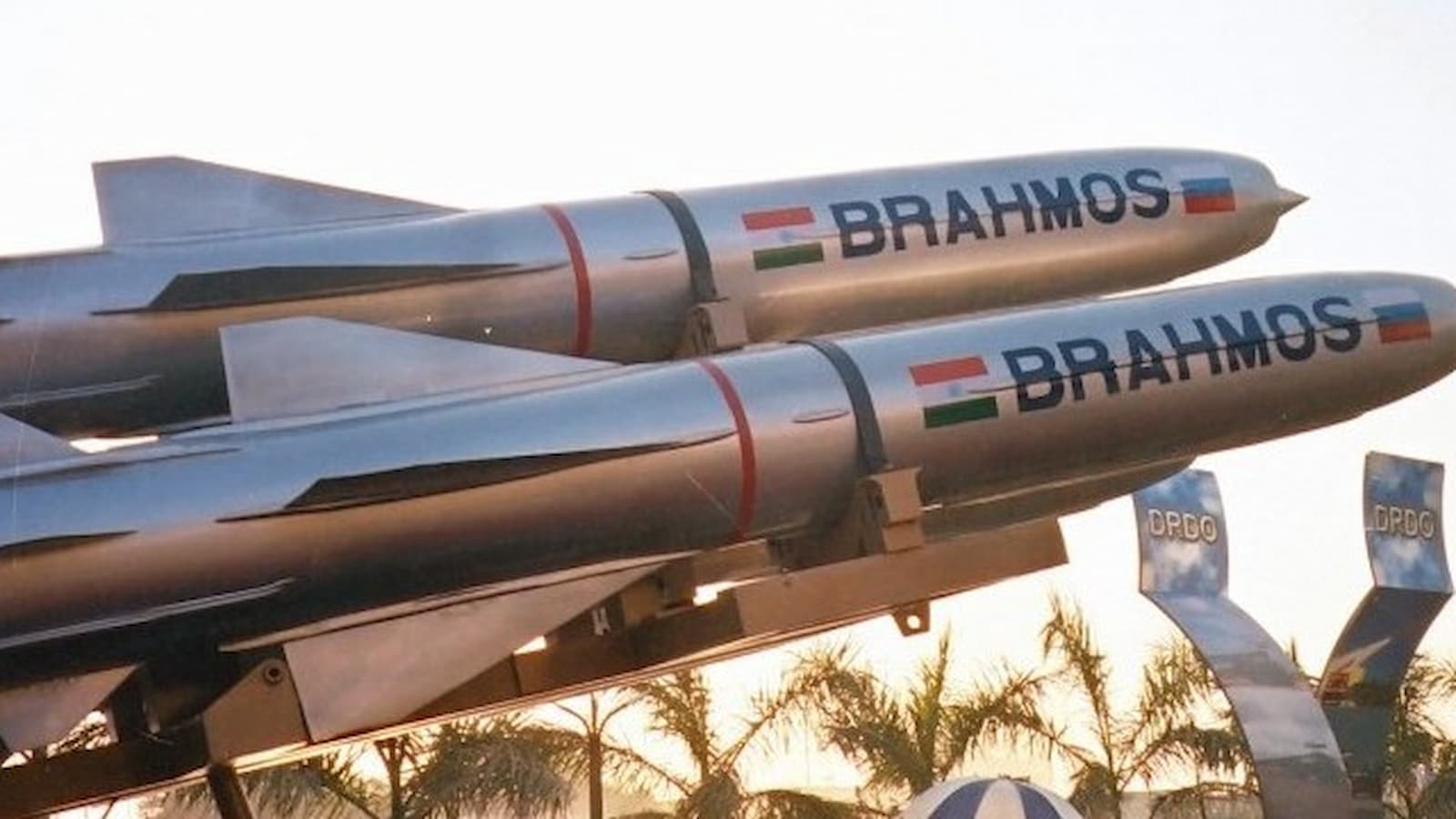
India’s Most Powerful Strike Missile: BrahMos started with an agreement signed on 12 February 1998 in Moscow. That pact brought together India’s DRDO and Russia’s NPO Mashinostroyenia to build a new supersonic cruise missile. The first successful launch came later, on 12 June 2001, from a static launcher near Chandipur in Odisha. From that point, the missile moved from a test project into a real weapon system.
The missile was made to be fast, hard to stop, and useful in many kinds of battles. BrahMos says the weapon is now in service with the Indian Army, Navy, and Air Force. It can be launched from land, ships, submarines, and aircraft. The company also says the missile works on a “Fire and Forget” principle, so once it is launched, it keeps going to its target by itself.
India Enters Elite Missile Defence Club After Successful DRDO Ballistic Missile Shield Tests
How it Grew into many Versions

At first, BrahMos was known for a range of about 290 km. After India joined the MTCR in 2016, BrahMos tested an extended-range version in 2017, and official BrahMos material says the newer variant reached 450 km. Later reports in 2025 and 2026 said an 800-km version is being prepared for future induction, but that appears to be the next major upgrade, not the basic missile already in service.
BrahMos also grew in stages called Block I, Block II, and Block III. Block I was the first land-attack version. Block II added target discrimination, so it could pick out the right target in a crowded area. Block III brought steep dive and mountain warfare capability, which made it useful in hilly terrain and for targets hidden behind mountains.
The missile also spread across platforms step by step. The Indian Navy started using ship-based BrahMos in 2005. The Indian Army began getting land-based versions in 2007. The submarine-launched version was tested successfully in 2013. The air-launched BrahMos-A was first fired from a Su-30MKI in 2017, after major changes were made to the aircraft.
BrahMos Feature Upgrades
Over time, more of BrahMos has been made in India. BrahMos said in 2019 that the missile had Indian propulsion, airframe, power supply, and other major indigenous parts. Another report said the G3OM navigation receiver, short for GPS, GLONASS, GAGAN on a Module, was tested on the missile and could give very high accuracy. That kind of work helped the project become more self-reliant.
This missile has also become an export product for India. BrahMos says the Philippines signed a landmark export contract in January 2022. Reuters reported on 9 March 2026 that Indonesia entered an agreement with India to procure BrahMos missiles. Reuters also reported on 30 May 2026 that India signed a BrahMos deal with Vietnam, while talks with Indonesia were nearing completion.
DRDO Develops Advanced Shield System for India’s T-90 Tanks
BrahMos is still moving forward. The official BrahMos site says BrahMos-NG is planned as a smaller, lighter, stealthier version that can fit on more aircraft and other platforms, including the Su-30MKI and later the Tejas. The same site also says BrahMos-II is being developed as a hypersonic weapon with a scramjet engine and a speed of Mach 5 and above. BrahMos-NG is reported to be heading toward first flight tests in 2026.
BrahMos has become a symbol of “Make In India” and now also “Make for the World.” The company says it has spent more than two and a half decades building a system that keeps getting better, with bigger reach, more local parts, and new versions for land, sea, air, and submarine use.
