
Türkiye-Saudi Arabia Defence Partnership: Türkiye has offered to expand its defence industry partnership with Saudi Arabia. The country says it has nearly 4,500 small and medium-sized defence companies and more than 1,400 ongoing projects worth billions of dollars.
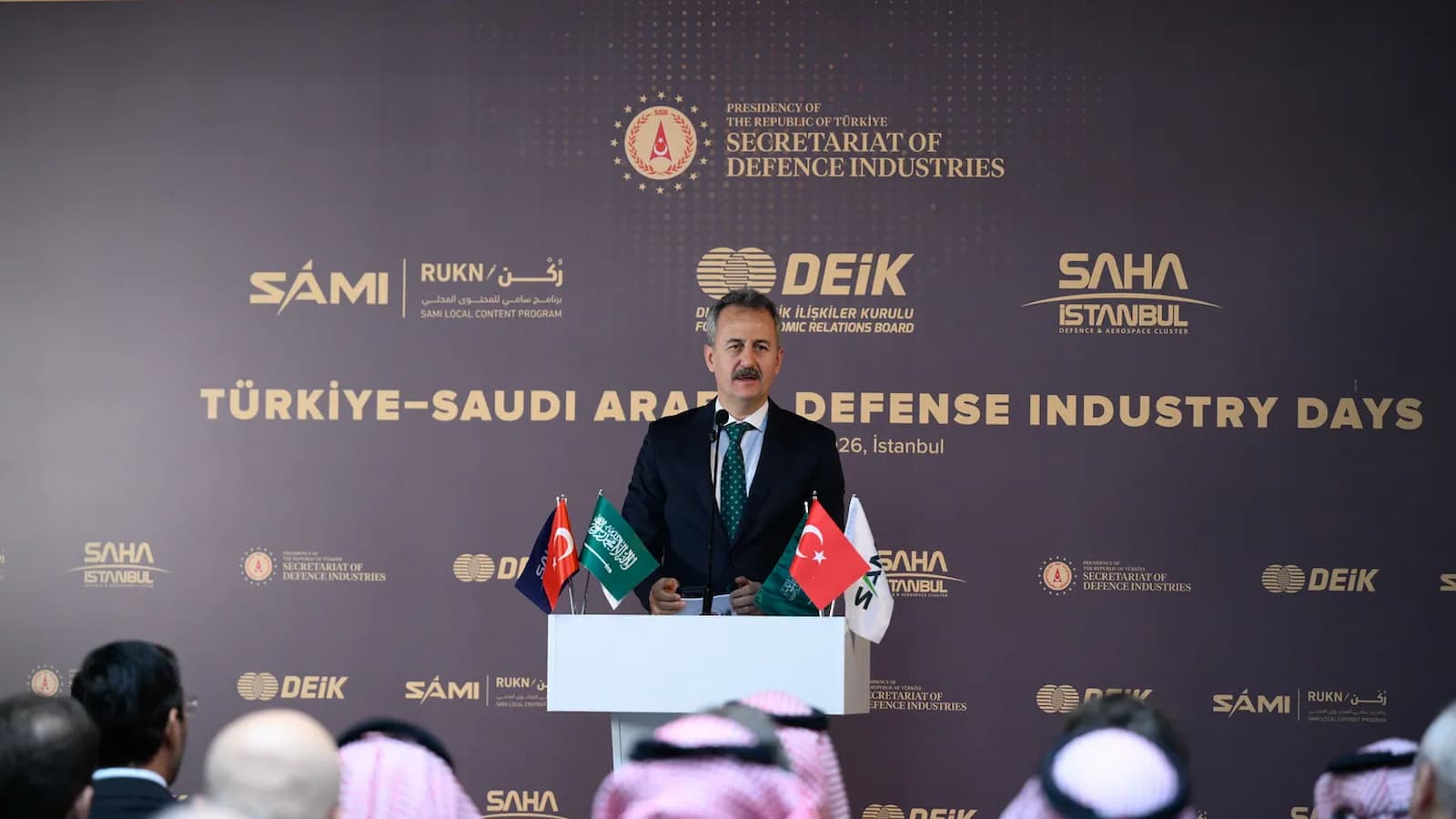
The offer was made by Haluk Gorgun, head of Türkiye’s Secretariat of Defence Industries (SSB), during the Türkiye-Saudi Arabia Defence Industry Days in Istanbul on November 12. The two-day event was organised by the Foreign Economic Relations Board (DEIK), SAHA Istanbul and Saudi Arabian Military Industries (SAMI).
Saudi Minister of State and Acting Governor of the General Authority for Military Industries (GAMI) Bandar Al-Khorayef also attended the event. Türkiye’s Deputy Industry and Technology Minister Cetin Ali Donmez and Istanbul Governor Davut Gul were among the other senior officials present. Around 69 Turkish and 30 Saudi companies also took part in business meetings to discuss new opportunities.
Bangladesh’s $2.13 Billion China Deal: Tarique Rahman Approves 20 J-10CE Fighter Jets
Türkiye Wants to Expand Joint Defence Projects With Saudi Arabia
Türkiye ready to expand defense industry cooperation with Saudi Arabia, backed by more than 1,400 projects and $120 billion portfolio, country’s top defense industry official says
https://t.co/OdQGhyk0aG
— Türkiye Today (@turkiyetodaycom) November 12, 2026
Gorgun said Türkiye has spent around 20 years building its defence industry under President Recep Tayyip Erdogan. It now wants to share its experience with friendly countries and develop new projects together.
“With our nearly 4,500 defence SMEs, over 1,400 projects, a roughly $120 billion portfolio, and our president’s mandate, we are ready to take every step we can to develop together,” Gorgun said.
He added that Turkish and Saudi officials have held 75 meetings over the past 3.5 years. These discussions involved GAMI, SAMI and the General Authority for Defence Development (GADD).
Both sides are also working on projects that can help Saudi Arabia produce more defence equipment inside its own borders. Under Vision 2030, Riyadh wants to manufacture at least 50% of its defence needs locally. Turkish companies are also discussing the creation of special defence centres of excellence in Saudi Arabia.
Saudi Arabia and Türkiye Share Defence Industry Goals
Al-Khorayef said Saudi Arabia’s defence production localisation rate has increased from 4% in 2018 to 27.3% by the end of 2025. The country wants to reach more than 50% by 2030.
He said Saudi Arabia is offering investment support to attract foreign companies. Technology transfer and long-term partnerships will also help the country build its own defence manufacturing industry.
Donmez also shared details about Türkiye’s growing economy and technology sector. The country’s annual exports are approaching $300 billion with manufacturing making up around $260 billion. Hightechnology exports have increased by 87.5% since the pandemic and high and medium-high technology products now account for 44.2% of total exports.
Turkiye’s R&D spending reached $24.8 billion in 2025, equal to 1.55% of its national income. The country also has around 318,000 R&D workers.
Donmez said defence and aerospace exports have grown from $248 million in 2002 to more than $10 billion. The sector now employs over 100,000 people across more than 4,000 organisations. He added that 80 defence R&D centres received 71 billion Turkish liras in government support last year. TÜBİTAK also provided 65 billion liras for more than 2,200 defence projects involving over 4,000 researchers.
Assam Cabinet Approves 6,000 Bighas for Defence Park Near Nellie
More Opportunities for Companies and Technology Projects
Istanbul Governor Davut Gul said the city plays an important role in bringing international businesses together. SAHA Istanbul Vice Chairman and Roketsan CEO Murat Ikinci also said stronger cooperation would help both countries improve their industries and develop new technologies.
Ikinci said the Makkah Agreement had created a way for both sides to work on joint production and technology transfer. He added that small businesses, subcontractors and technology startups should also be included.
Future projects could cover autonomous systems, air and missile defence, propulsion technology and space systems. SAHA Istanbul itself has more than 1,300 member companies and is one of Europe’s largest defence technology clusters
