

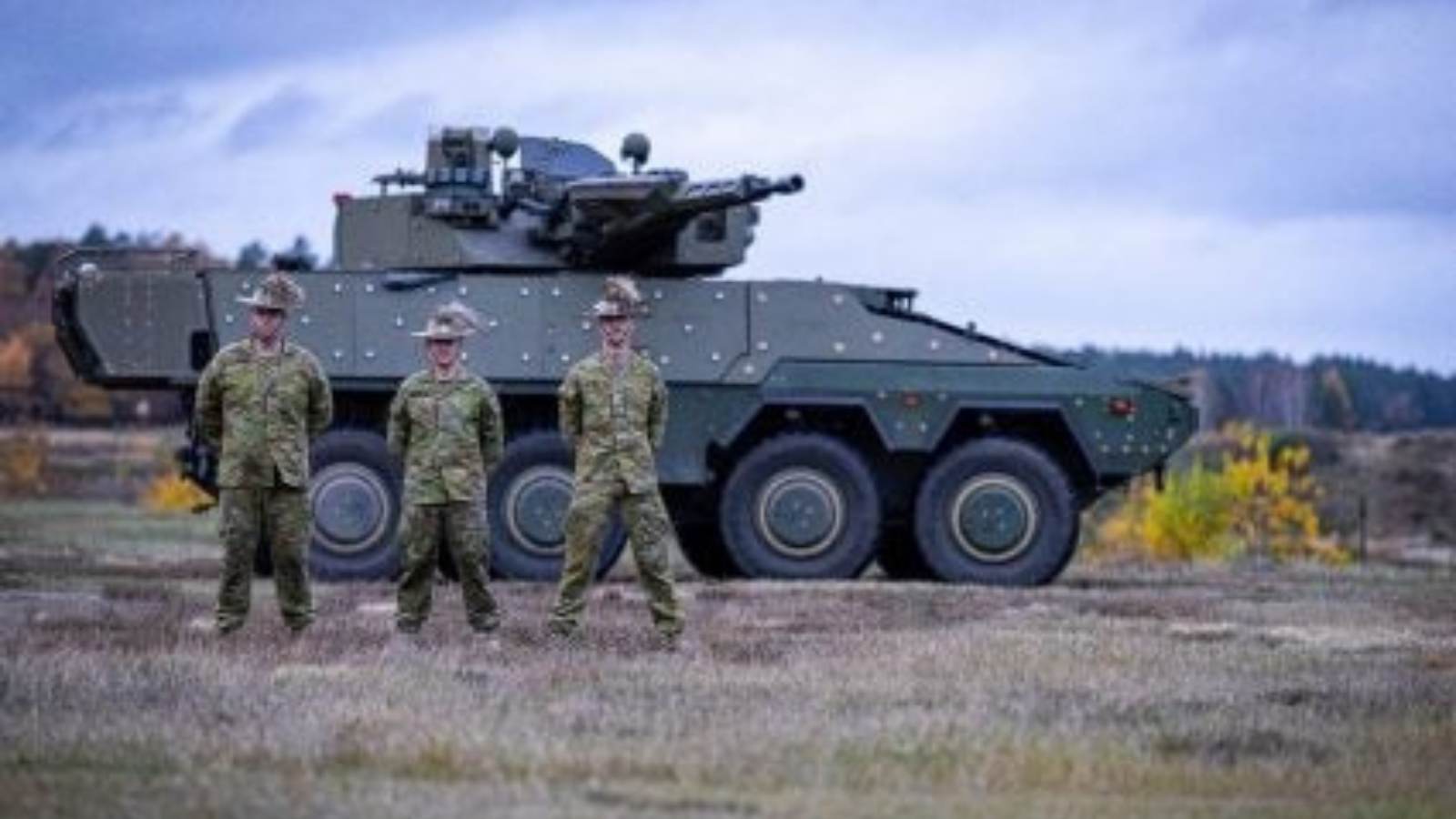
Block II Boxer Vehicle: The Australian Defence Force said that three troops from the 2nd/14th Light Horse Regiment (LHR) assisted with the platform’s design late in 2023, in advance of the delivery of further Boxer reconnaissance vehicles.
As part of its Block I procurement, the Army inducted 25 Boxer vehicles between 2019 and 2021 to serve as an interim cavalry. Using the knowledge gained from operating the Block I cars, the remaining 186 Block II vehicles will be delivered starting this year.
Block II Boxer Vehicle
The MK30-2 cannon and MAG58 machine gun were tested in harsh weather conditions in Unterluss, Germany, together with the unique programmed ammunition capabilities.
Tests involved testing the new programmed munitions capabilities and firing the MAG58 machine gun and MK30-2 cannon in adverse weather.
Lance Corporal Ben Crawford, the crew commander, and Trooper Liam Skinner, the driver, fired the Block II turret’s 30-millimeter training and programmed rounds.
A briefing on the Block II vehicle design, the improved weapon control systems, and the functioning of the combat intelligence, surveillance, and reconnaissance system were covered during the visit.
US Army Radar Testing: US Army splits testing phase of future missile defense radar
Boxer evolution
The Organisation for Joint Armament Co-operation (OCCAR), a European arms body, is in charge of the Boxer MIV, an 8×8 multipurpose armoured vehicle. The vehicle is suitable for use in relief and humanitarian missions, as well as high-intensity confrontations.
Although it is produced in Hamburg, Germany by Rheinmetall, the Australian labour force engaged in its creation will contribute to the Boxer’s upkeep, advancement, and improvements. Additionally, they will be employed to facilitate prospective export prospects.
Certain versions of the vehicle will be fitted with Block I (Kongsberg) and Block II (Electro Optic Systems) remote weapon stations and anti-tank guided missiles.
OCCAR helps in the Boxer’s production as well. Australia became a member as a “observer state,” sharing with the commonwealth the knowledge and insights gained by the member countries.
Through OCCAR, all user nations will maintain cooperative relationships throughout the vehicle’s lifespan since customers may exchange spare parts and interoperable platform components.
Indeed, it was recently declared that within the next year or two, the UK will have to make “temporary concessions” for a combination of Boxer components. This will include asking Germany, Lithuania, and the Netherlands—other OCCAR members in the Boxer program—for spare components that may be utilised for the UK Boxers while the country waits for supplies from its own supply chain.
Block II is more focused on soldiers
Trooper Skinner found the significant emphasis on crew safety to be impressive.
The Block II design’s emergency escape hatch for the driver ensures increased survivability. Seeing that Block II is now incorporating the lessons learnt from Block I gave me confidence to move on.
In order to promote future design choices for Boxer with an active protection system, soldiers took part in a working group with Rheinmetall in Kassel.
They were also given an update on Australia’s and Germany’s ballistic and blast testing programmes.
Crawford said, “I was able to tell them how it has been implemented and I found it extremely beneficial to see the input that soldiers from 2/14 LHR have made to the design of Block II Boxer, particularly in the crew operation of the weapon systems.”
