
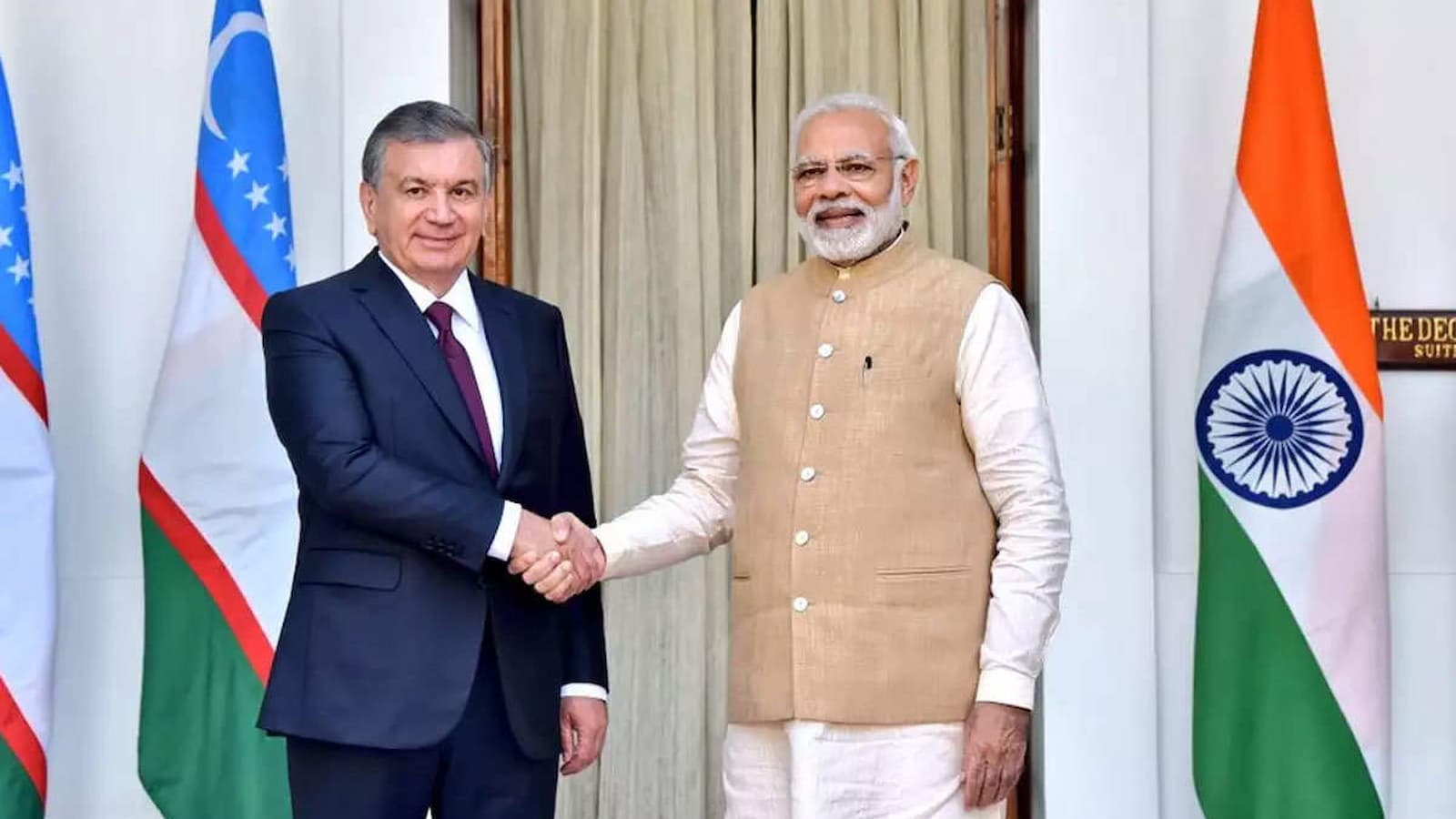
India-Uzbekistan Partnership: India and Uzbekistan have taken their relationship to a new level. During Prime Minister Narendra Modi’s state visit to Uzbekistan on August 29-30, 2026, both countries agreed to raise their Strategic Partnership to a Comprehensive Strategic Partnership.
The new arrangement covers many areas, but defence and security remain important parts of it. The two sides want closer military cooperation, better coordination between security agencies and more work in defence industries. Trade, energy, technology, education, healthcare and connectivity are also part of the wider plan.
The visit was Modi’s fourth trip to Uzbekistan. He met Uzbek President Shavkat Mirziyoyev in Tashkent for detailed talks on bilateral and regional issues. The leaders also discussed ways to make the relationship more useful for both countries in the coming years.
ASELSAN Enters Global Defense Top 40; Orders Hit $4.9 Billion, Backlog $23.2 Billion
India-Uzbekistan Defence Ties to get more Attention
Key outcomes from today’s talks with President Shavkat Mirziyoyev in Tashkent include:
Elevation of India-Uzbekistan relations to a Comprehensive Strategic Partnership.
Boost trade to over 5 billion dollars by 2030.
Increase cooperation in infrastructure, DPI, AI, critical… pic.twitter.com/aSpqLm7iNt
— Narendra Modi (@narendramodi) August 30, 2026
Defence cooperation between India and Uzbekistan is already supported by regular military exchanges and joint activities. Now, both countries want to take this work further.
The leaders welcomed the work being done through the Joint Working Group on Military Cooperation. They said new areas are being explored in defence industries. The plan includes more institutional exchanges, training and capacity building. There is also interest in stronger links between companies from the two countries so they can look at joint production and other forms of defence cooperation.
This can help India and Uzbekistan share experience and improve their ability to deal with common security challenges. Defence cooperation is also being linked with India’s larger focus on defence manufacturing and strategic self-reliance.
DUSTLIK Exercise Strengthens Military Cooperation
One of the important parts of the military relationship is the DUSTLIK exercise. India and Uzbekistan hold this exercise every year by taking turns between the two countries.
The seventh edition was held at the Gurumsaray Field Training Area in Uzbekistan’s Namangan region from April 12 to April 25, 2026. Around 60 Indian personnel took part. The Indian team included Army personnel mainly from the MAHAR Regiment along with Indian Air Force personnel. Uzbekistan also sent around 60 Army and Air Force personnel.
Dutch Defence Official Calls for European-Built Ballistic Missile Interceptors
The exercise was aimed at improving joint military skills, especially for operations in semi-mountainous areas. It gives soldiers from both sides a chance to train together and understand how the other force works. The two leaders later welcomed the successful holding of the latest DUSTLIK exercise in April 2026.
Fight Against Terrorism and New Security Threats
Counter-terrorism is another major part of the India-Uzbekistan relationship. Both countries have said they want the Joint Working Group on Counter Terrorism to remain an important channel for security cooperation.
India and Uzbekistan have strongly opposed terrorism in all forms. Their cooperation also covers wider security concerns such as organized crime, extremism, cyber threats and illegal drug trafficking.
The two countries want security agencies to have closer contact and share experience and information where needed. This is important because many of these threats can cross borders and can’t be handled by one country alone.
The official joint statement also highlighted the growing coordination between the defence and security agencies of India and Uzbekistan through regular exchanges, institutional mechanisms, capacity building and joint activities.
India to Get Hundreds of UK’s Martlet Missiles to Boost Drone Defence
Trade Target Raised To $5 Billion By 2030
Uranium and Critical Minerals
India and Uzbekistan are also moving ahead on a long-term arrangement for uranium supply. During the visit, both sides discussed strengthening cooperation in peaceful nuclear energy and critical minerals.
These areas are important for India’s future energy and industrial needs. Critical minerals are also needed for many modern industries and technologies.
More work in Technology, UPI and Education
The partnership also covers digital technology, AI, space, healthcare and agriculture. Indian UPI users will be able to use UPI apps to make merchant payments through Uzbekistan’s UZQR system. Both countries will also work together on education and culture through a 2026-30 exchange programme.
India will offer 100 Lal Bahadur Shastri Hindi scholarships and set up an ICCR Sanskrit Chair. They’ll also help protect the ancient Buddhist sites of Fayaz Tepa and Kara Tepa and expand youth exchanges.
