

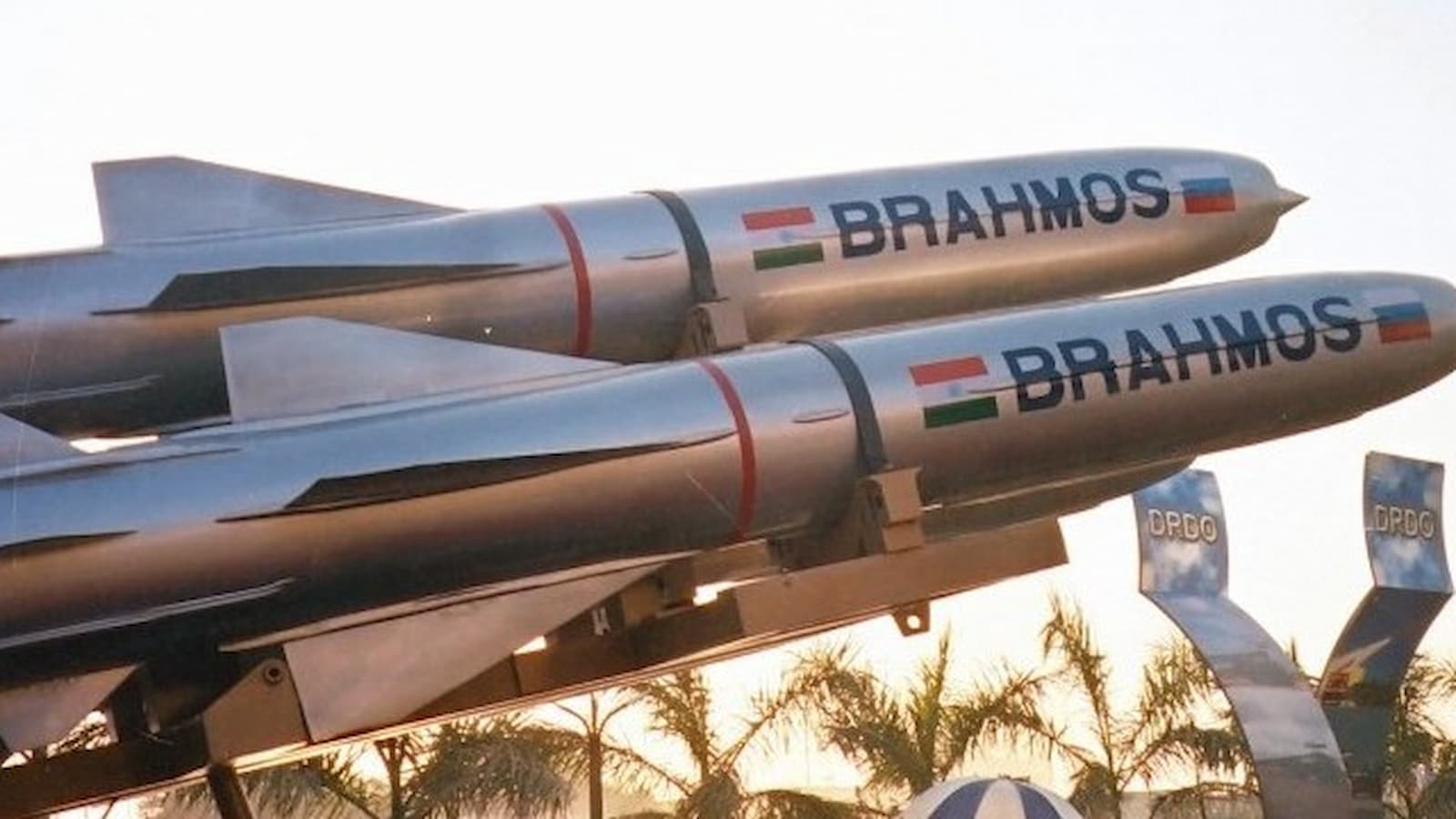
BrahMos Missile Costs: India’s BrahMos missile line is heading for a big price drop. BrahMos Aerospace CEO and Managing Director Dr. Jaiteerth R. Joshi has said the missile’s cost may come down by nearly 20% in the next 18 to 24 months. The big reason is simple. More parts are now being made in India, and the program is depending less on imported Russian items. The goal fits nicely with “Make in India” and the wider drive for defence self-reliance.
According to a video on RT India’s X account, “India and Russia are working on a 800-km strike version of a BrahMos, a submarine-launched variant of BrahMoS under the P75I programme; a miniaturised lighter version of BrahMoS for integration with aircraft and a hypersonic BrahMos missile.”
Why the price is falling?
A lot of the savings are coming from the small but important pieces that make the whole missile work. Officials say more Indian-made components are being used, more raw materials are being bought locally, and some key subsystems are now made inside the country. Better factory work and smoother supply chains are also helping. In the last 18 months, the program has already seen around 24% lower raw material costs and about 10% lower manufacturing and component costs. That is a serious cut, not pocket change.
Hyderabad Defence Firm Drogo Aerospace Delivers First Batch of Army Drones
New Warhead
One of the biggest changes is the move to make the BrahMos warhead in India. Earlier, some warhead-related parts depended on Russian supply. Now Indian firms are taking over more of that work. Solar Defence and Aerospace Limited, or SDAL, has delivered India’s first indigenous BrahMos warhead for qualification trials, which is a major step toward full local production. A fully approved home-made warhead should help lower cost, steady the supply line, and make the whole missile chain less dependent on outside vendors.
Speaking at the flag-off ceremony of the 100th indigenous BrahMos booster at Solar Industries’ facility in Nagpur, BrahMos Aerospace CEO and Managing Director Jaiteerth Joshi said, “Future developments include work on BrahMos-NG and very long range variants, with research also focused on lighter designs using composite materials. Final specifications will be determined after design validation and simulation studies are completed.”
He added that the upcoming versions are expected to reduce missile costs by nearly 20% while also increasing the level of indigenous content in the weapon system.
On the indigenous warhead programme, Joshi said, “Solar Industries has also done warhead trials and we will be going ahead with the trials in near future and once it is successful, we will implement and replace the thing with the indigenous warhead.”
“The miniaturised variant (BrahMos NG) will feature a smaller radar cross-section than its predecessor and will have an active electronically scanned array (AESA) radar seeker for heightened precision,” a source in DRDO told TOI. “Five such BrahMos NGs can be carried by a Sukhoi fighter, eight missiles by a land-based launcher and unlimited missiles by a warship,” the source said, adding, “the cost-effective BrahMoS-NG will have the technology of 2020-30s as compared to the 1990 technology in the existing BrahMos.”
What is BrahMos?
BrahMos is a supersonic cruise missile. That means it flies faster than sound and stays low while moving toward its target. It is used by the Indian Army, Navy, and Air Force in different versions. It is one of India’s most important strike weapons because it is fast, accurate, and hard to stop.
The push for local production is not only about saving money. It also means more work for Indian factories, better supply security, and fewer delays if global shipping gets messy. BrahMos officials say the programme is already moving toward deeper localisation, and some reports say the system could reach nearly 85% indigenisation in the near future. There is also more work going on for BrahMos-NG and longer-range versions, which shows the programme is still growing, not just getting cheaper.
GDELS to Showcase Pandur GBAD and Counter-UAS Systems at Eurosatory 2026
Defence strength
If the cost really falls by close to 20%, India could buy more missiles for the same money. That helps inventory levels, planning, and readiness. It also gives Indian industry a stronger place in the defence supply chain. In simple words, the country is trying to make a world-famous missile with more Indian hands on the tools, more Indian parts in the body, and less money leaking out to foreign suppliers
