

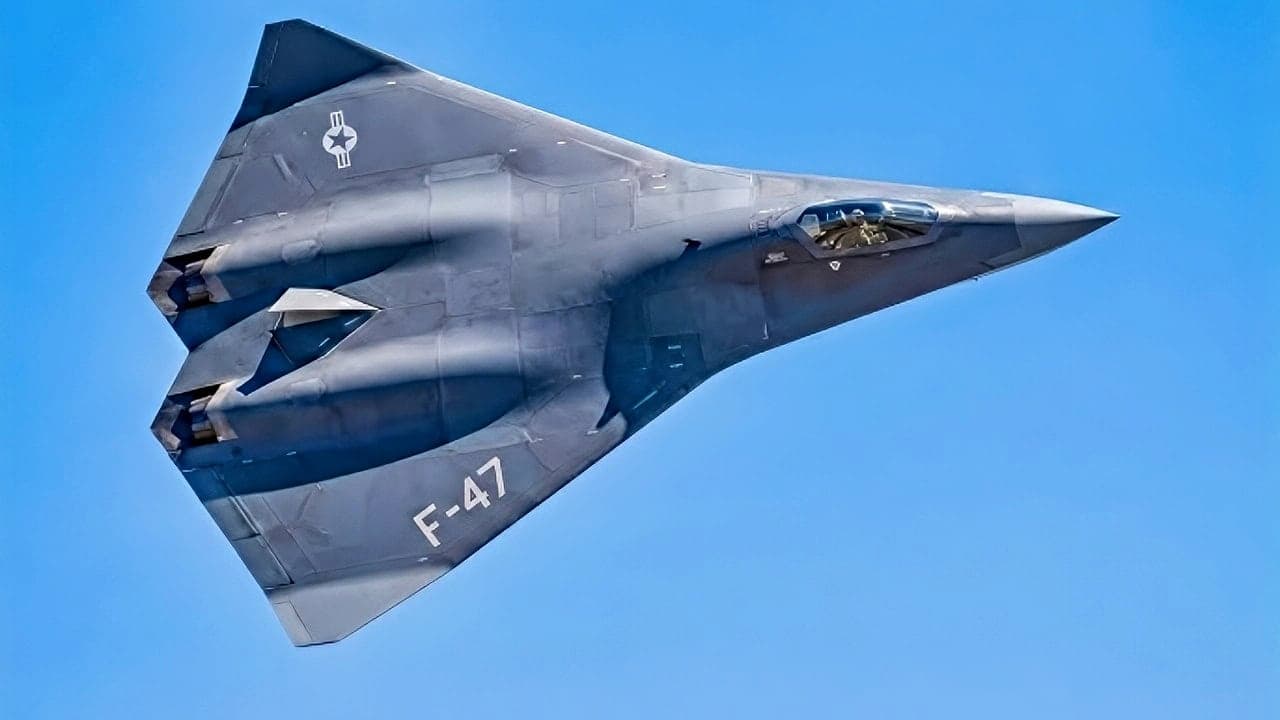
Combat Drones for 185 F-47 Fighters: The famous “Top Gun” line about being each other’s “wingman” may sound like something from an old fighter movie. But in modern military aviation, the idea of a wingman is changing fast. Pilots may soon have unmanned aircraft flying beside them and helping them during combat.
This idea is a major part of the US Air Force’s plans for the Boeing F-47. The F-47 is being developed under the Next Generation Air Dominance, or NGAD, program. The Air Force awarded Boeing the Engineering and Manufacturing Development contract in March 2025 and describes the aircraft as its crewed sixth-generation fighter. The service says the F-47 will combine advanced stealth, sensors and long-range strike abilities.
The Air Force also plans to use the F-47 as part of a larger family of systems. One important part of this plan is the Collaborative Combat Aircraft, or CCA. These are unmanned fighter-like aircraft that can fly with crewed jets and carry out different jobs.
What Is NAVEM-A Mk1? Inside DRDO’s Advanced Viscoelastic Isolation Mounts Technology
F-47 and its New Robotic Wingmen
Instead of sending one costly F-47 into a dangerous area alone, the US could send it with several unmanned aircraft. The F-47 would work as the main command aircraft while the CCAs could carry out different jobs. They could collect information, conduct electronic warfare, act as decoys or carry weapons. The US Air Force has set a goal of at least 1,000 CCAs. It sees the drones as a way to add more combat power at a lower cost and create “affordable mass.”
AI and automation will also play a major role. The CCAs are being developed as unmanned “loyal wingmen” that can work with crewed fighters while human pilots remain involved in key decisions. The F-47 is expected to have a combat radius of more than 1,000 nautical miles and a speed above Mach 2. With at least 185 F-47s planned, more than 1,000 CCAs could mean roughly five drones for every fighter.
Two CCA Aircraft are Already Flying
This is not only a future idea sitting on a drawing board. Two important CCA designs have already entered flight testing. General Atomics is developing the YFQ-42A. The aircraft made its first flight in August 2025. General Atomics later announced that the aircraft had completed its first semi-autonomous airborne mission using third-party mission autonomy software in February 2026. The company says the software allowed the aircraft to receive and carry out autonomous mission commands while working with its flight and mission systems.
General Atomics later gave the aircraft the name “Dark Merlin.” The company says several YFQ-42A aircraft have already been built and flown during testing. The aircraft can also perform autonomous takeoffs and landings as part of the development work.
The second aircraft is Anduril’s YFQ-44A. Anduril began flight testing on October 31, 2025. The company says the aircraft is being developed around autonomous operations and is designed as part of the US Air Force’s CCA effort.
The two aircraft are meant to show that future combat drones don’t necessarily need a pilot sitting inside them. Their software can help them fly and perform parts of a mission while remaining connected to human-controlled aircraft.
This could give a fighter pilot a much larger view of the battlefield. A CCA could move ahead of the crewed aircraft to search for threats. Another could carry weapons. Another could help with electronic warfare. Others could be used as decoys to make an enemy unsure about which aircraft is the real threat.
Norway Orders 20 Patria 6×6 Vehicles With Kongsberg Weapon Stations
More Aircraft for Less Money?
Cost is one of the main reasons behind the CCA program. The F-47 will be a highly advanced and expensive fighter, so the Air Force wants more combat power without having to buy hundreds of extra crewed jets.
This is where the idea of “affordable mass” comes in. The plan is to build many unmanned aircraft that can add weapons, sensors and other abilities to a smaller fleet of costly fighters.
With at least 185 F-47s planned and more than 1,000 CCAs targeted, each fighter could potentially work with several drones during a mission. The system is still being developed. The F-47’s first flight is expected in 2028, while work continues on the CCA fleet and its autonomous technology.
