

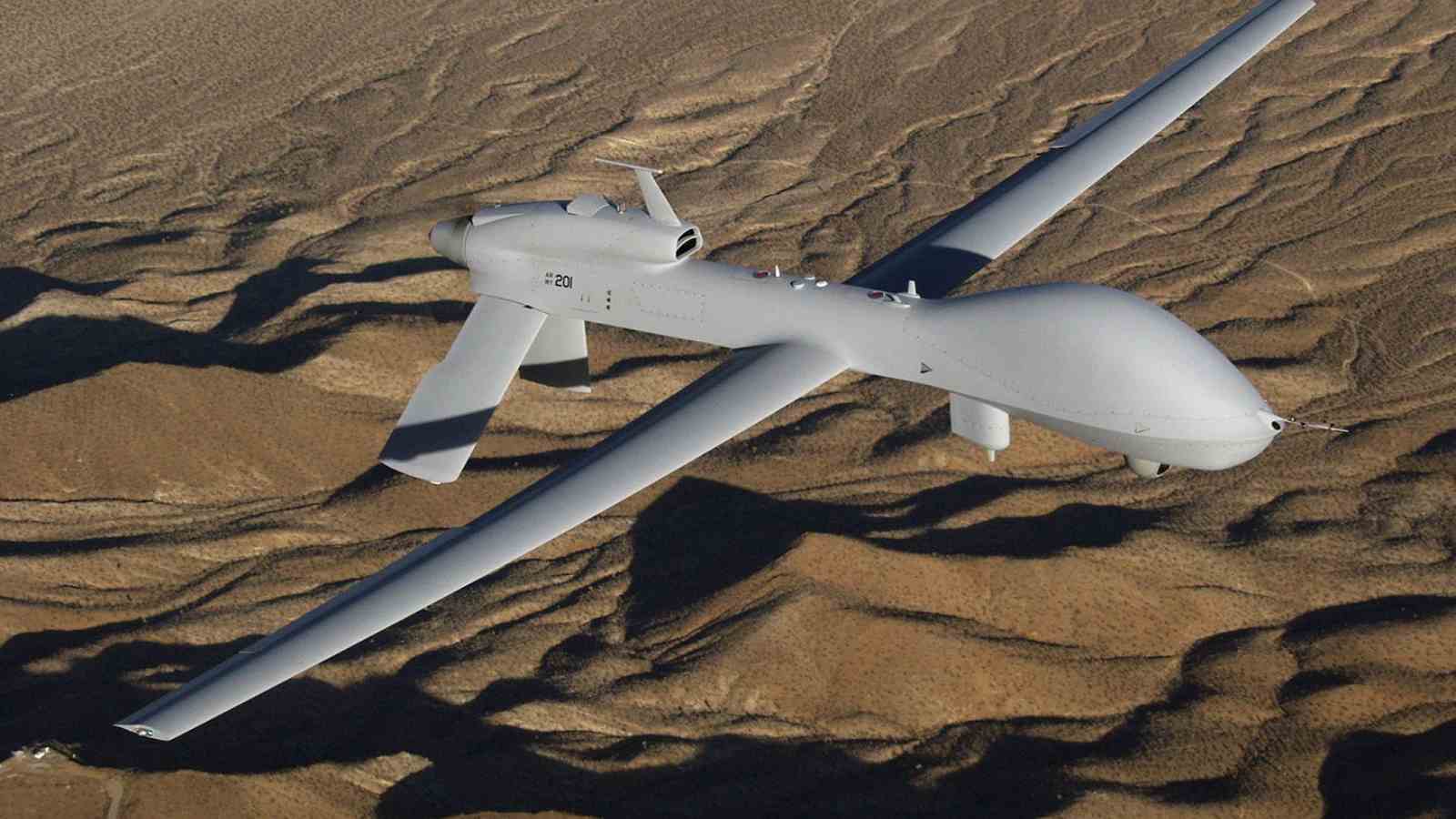
Gray Eagle drones: US national defence capabilities company General Atomics Aeronautical Systems Inc., with its headquarters located in Poway, California, has secured a $389 million contract to provide the US Army with modernised, extended-range drone systems, or MQ-1C-25M Grey Eagles.
Redstone Arsenal’s Army Contracting Command in Alabama awarded the contract.
The most recent deal was an incentive contract with a set price. The MQ-1C-25M Grey Eagle is a surveillance drone that will be updated to improve its usefulness and range.
In cooperation with the US Army, General Atomics Aeronautical Systems successfully finished the first round of production acceptance test flights for the Grey Eagle extended range (GE-ER) unmanned aircraft system (UAS) in 2021. For military operations, the GE-ER UAS is intended to offer extended surveillance, communications relay, and weapon delivery capabilities.
Ukraine plans to produce 100-km-range air defence systems
Gray Eagle drones
The US Army is set to use these drones, which are scheduled for delivery by November 29, 2024, for strategic reconnaissance and surveillance tasks.
Military reconnaissance capabilities have advanced with the MQ-1C-25M Grey Eagle modernised extended range system, which provides a tool for tracking and countering a variety of threats.
On June 15, 2023, General Atomics Aeronautical Systems, Inc. (GA-ASI) accomplished a significant milestone when its 200-horsepower heavy fuel engine 2.0 made its first flight on a Grey Eagle aircraft at the El Mirage flight site.
This engine is intended to replace the existing 180-horsepower engine used in the Grey Eagle extended-range unmanned aircraft system. It is a component of GA-ASI’s internal research and development programme, which was started in 2016.
As part of a US Army-funded programme to update the UAS, General Atomics Aeronautical Systems successfully tested enhanced datalink and avionics enhancements for the MQ-1C Grey Eagle extended-range UAS system in 2022.
The experiments showed that the GE-ER could sustain a connection and support high-bandwidth data rates with geostationary earth orbit Ku/Ka-band satellites and medium earth orbit Ka-band satellites using standard hardware and software. Thanks to this development, the UAS may now operate continuously across several satellite constellations.
