
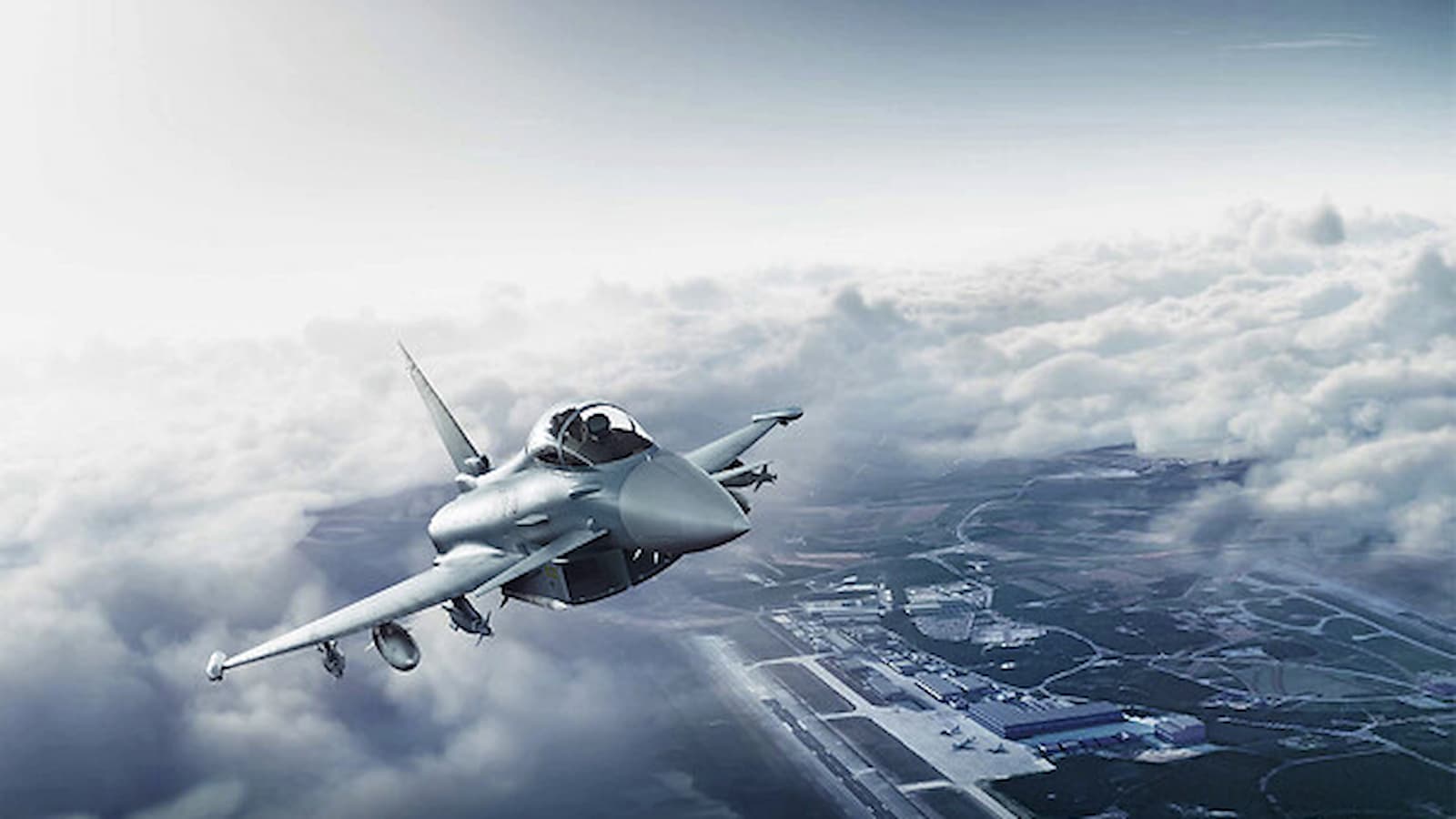
Eurofighter Typhoon: Airbus is taking a strong stand in the competitive bidding process for India’s massive Medium Multi-Role Fighter Aircraft (MRFA) acquisition using its most recent Eurofighter Typhoon model. Airbus promises a significant boost in capability with its Tranche-5 derivative, securing a place in the 114-jet purchase that India is keen to acquire, according to Bulgarian Military.
It is taking a strong stand in the competitive bidding process for India’s massive Medium Multi-Role Fighter Aircraft (MRFA) acquisition using its most recent Eurofighter Typhoon model. Airbus promises a significant boost in capability with its Tranche-5 derivative, securing a place in the 114-jet purchase that India is keen to acquire, according to Bulgarian Military.
US and China Defense Chiefs Hold First Talks in 18 Months to Address Rising Tensions
One of the many cutting-edge innovations that distinguish the Block-5 Eurofighter from its rivals is the E-Scan active electronically scanned array (AESA) radar. This high-quality sensor provides exceptional situation awareness and target-tracking capabilities, which are essential for modern air combat situations. In addition to being more advanced technologically, the Eurofighter has advanced defence systems and a human-machine interface (HMI) that makes the pilot’s job easier.
But Airbus doesn’t want to just sit back and watch. Parts of the latest Long Term Evolution (LTE) package have been added to their Tranche-5 platform. The goal of this development project is to investigate improvements in engine performance, operational flexibility, pilot interfaces, and mission systems.
Advanced Avionics
To maintain the Eurofighter’s status as a top combat aircraft, a significant redesign of its avionics is planned, including the introduction of cutting-edge hardware and software. The advances in LTE not only improve the capabilities of the Eurofighter, but they also open the door for Europe’s Future Combat Air System (FCAS). This upcoming air combat network is expected to heavily rely on the Eurofighter.
Beyond its state-of-the-art electronics, the Eurofighter is an extremely powerful aircraft. The projected Indian variant will be equipped with a powerful range of air-to-air missiles, including as the dependable AIM-9L, AMRAAM, ASRAAM, and IRIS-T. Additionally, the jet can carry a variety of laser-guided bombs, making it versatile for a broad range of combat scenarios.
The Eurofighter is also capable of long-range missions because of its external fuel tanks, which are approved for use in supersonic travel. Furthermore, the aircraft is authorized for air-to-air refueling using various types of tankers, ensuring an extended operational range.
Differentiated regulations to be implemented for civilian and defense use of drones
Rafale Is Still Less Expensive
Airbus’s Tranche-5 Eurofighter makes a strong case for India’s MRFA tender with to its cutting-edge features, future-proof design, and tested weaponry. The Eurofighter was defeated by the Rafale in the last MRCA tender due to price, rather than technological superiority. The various design philosophies and production tactics used by the manufacturers are the main source of the Rafale’s cost-effectiveness. The development of the Eurofighter Typhoon is a global works involving enterprises from four distinct countries: the United Kingdom, Germany, Italy, and Spain.
Even though this cooperative method has some good points, it is hard to coordinate production between countries that have different rules and ways of doing things in the business world. This often causes costs to be very high. A lot of thought went into making the typhoon work with air power as well. This meant that more advanced, and often more expensive, technology had to be used.
Orders Are Needed by Eurofighter
Eurofighter Economic Impact Assessment paper, which was put together by PricewaterhouseCoopers (PwC) subsidiary Strategy&, presents a “growth scenario” that projects the possible sales of up to 287 additional aircraft, some of which are contracted but not yet delivered.
The analysis, which the Eurofighter consortium made public on April 9, suggests that consortium members and exporting nations might buy hundreds more adaptable combat aircraft. According to the analysis, a “base scenario” that includes the present fleet of 680 planes spread across nine countries, along with 83 planned orders of Quadriga and Halcon I/II for Germany and Spain, respectively, would only sustain a very minimal production rate for a few years. But it also says that “more contracts for export and domestic sales are essential.”
In addition to the 38 Quadriga and 45 Halcon I/II jets that are currently in the pipeline, PwC projects that 130 export nation sales and 74 partner nation sales will be required to maintain production across the final assembly factories in Manching, Germany; Caselle, Italy; Getafe, Spain; and Warton, UK. Strong competition is anticipated for India’s MRFA contract. Nevertheless, Airbus is committed to using the Eurofighter to establish itself as a strong rival in contemporary air combat.
