

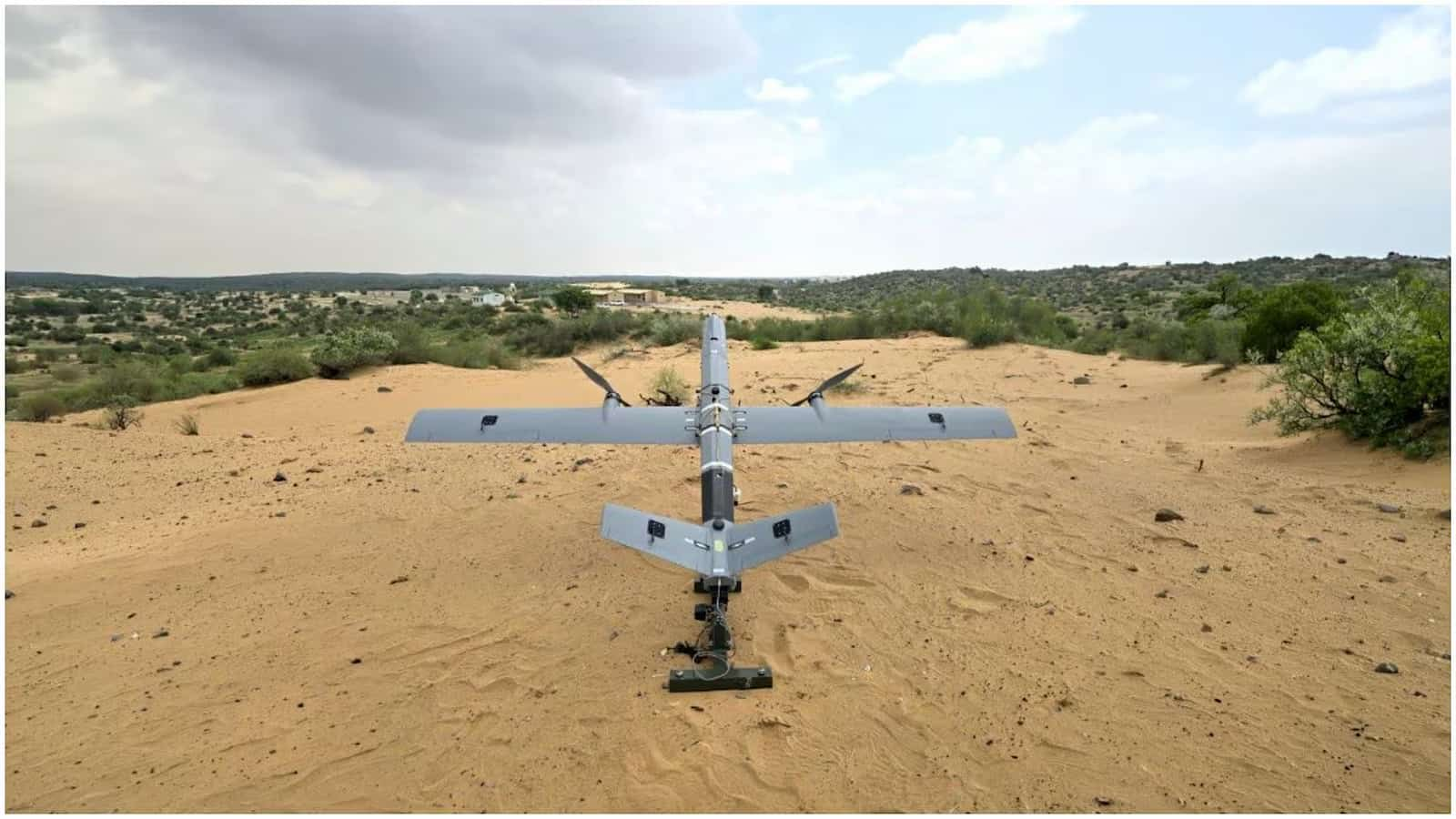
Nagastra 2 Indian Army Trials: India has made another move towards building its own advanced defence technology as Nagastra 2 has successfully completed technical trials for the Indian Army. The anti-tank loitering munition has been developed by Nagpur-based Solar Defence and Aerospace Ltd. to help the Army target armoured vehicles with greater accuracy.
The company said the trials took place at the Mahajan Field Firing Range (MFFR) in August 2026. The Army’s personnel observed the system’s performance and checked whether it met the required operating and electronic protection standards. According to reports published on October 23, 2026, the company is also supplying Nagastra 2 to the Indian Army.
Main Features of Nagastra 2
Nagastra 2 is a loitering munition, which is a type of drone-based weapon that can stay in the air while a target is identified before attacking it. It’s designed to deal with armoured targets and give the Army another option for precision strikes.
The system carries a 4 kg tandem shaped-charge warhead. According to the company, it can penetrate up to 650 mm of rolled homogeneous armour (RHA), a standard type of armour used to measure penetration capability. It also has surveillance cameras for both daytime and nighttime operations.
Sweden Seeks Parliament Approval for NATO Military Deployments in 2027
Nagastra 2 Range and Flight Time
Nagastra 2 has different operating ranges depending on how it’s used during a mission. In recover-and-reuse mode, its range is up to 25 km. In fire-and-forget mode, it can travel up to 50 km.
The system can remain in the air for up to 60 minutes. Recover-and-reuse mode allows the munition to be recovered for another use when the mission conditions permit it. Fire-and-forget mode is designed for missions where the weapon is sent towards its target without being recovered afterwards.
Protection Against Electronic Warfare
Another important feature is its Electronic Counter-Countermeasures (ECCM) capability. This is designed to help Nagastra 2 keep working when electronic warfare affects communication and navigation systems.
It offers protection against threats such as communication jamming, GPS jamming and GPS spoofing. GPS spoofing involves sending false location signals to confuse a navigation system. Such protection is important as modern battlefields increasingly depend on drones, satellite navigation and electronic communication.
Indian Army’s Earlier Nagastra 1R Order
Solar Defence and Aerospace Ltd. has also supplied loitering munitions under an earlier Army order. In June 2025, the Indian Army ordered around 450 Nagastra 1R systems from the company. The Army received the consignment in October 2026, according to reports.
UK Seeks Closer Defence Ties With US to Boost Weapons Production
Nagastra 1R comes with reusable launcher equipment and a 360-degree gimbal camera. A thermal camera can also be added for night operations. The system uses its own encryption for video and telemetry communication and has a reported Circular Error Probable (CEP) of 2 metres. CEP is a measure of targeting accuracy.
The company has stated that Nagastra 1R contains more than 80% indigenous content. The system has also been tested at locations including Ladakh and Babina near Jhansi in Uttar Pradesh.
