

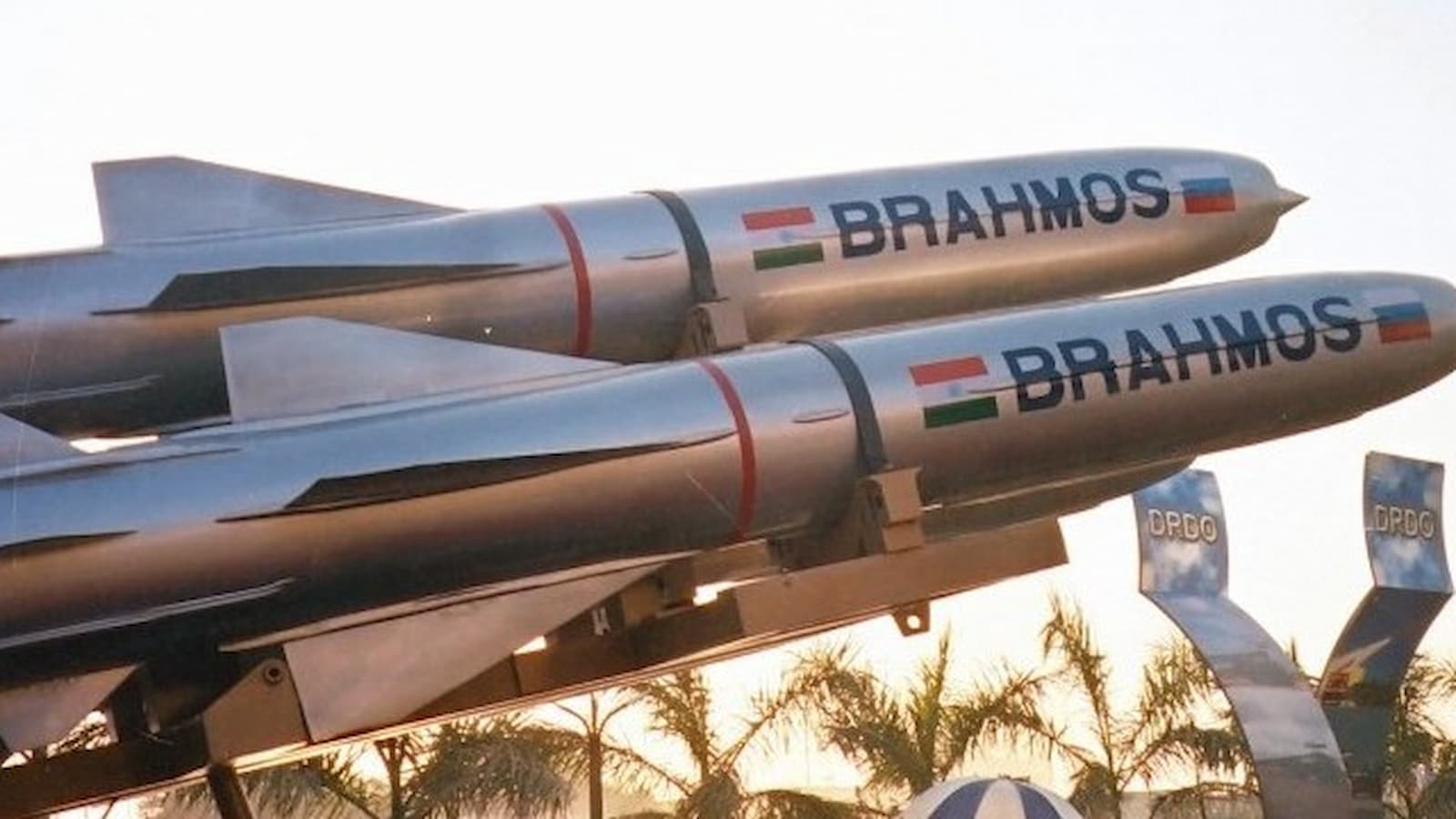
BrahMos missile: The Indian government wants to sell more than just the BrahMos cruise missile to people outside of India as part of the “Make-in-India” scheme. They also want to sell Tejas fighter jets and advanced light helicopters. But experts say there is still more that needs to be done to make the country’s defense industry stronger.
On April 19, New Delhi delivered the first batch of BrahMos supersonic cruise missiles to the Philippines, a development that could strengthen India’s position as a significant defence supplier in Asia.
The country in Southeast Asia has agreed to pay $375 million to India for the weapon system. As per the agreement from January 2022, New Delhi will provide three missile batteries along with their launchers and other equipment.
The Gulf War in 1991 was the main reason BrahMos was needed. Thus, in 1998, Dr. APJ Abdul Kalam, the chairman of the Defense Research and Development Organization (DRDO), and NV Mikhailov, the deputy defence minister of Russia, inked an agreement between the two countries.
The Russians own 50.5% of BrahMos Aerospace, while the Indians own 49.5%. It was set up as a partnership between DRDO and the Russian space company NPO Mashinostroyenia (NPOM). The Brahmaputra and Moskva rivers are in Russia and India, respectively, and are where BrahMos got its name.
The BrahMos missile was initially tested on June 12, 2001, in Chandipur, Odisha, using a land-based launcher. Since then, different missile iterations have been launched, improving it.
Vice Admiral Dinesh K Tripathi appointed as the new Indian Navy Chief
A Strategic Importance
BrahMos is a two-stage missile that uses a booster made of solid propellant.In the first step, the missile is sped up until it goes faster than sound, and then it breaks apart. The second stage’s liquid ramjet helps the rocket get close to three times the speed of sound during the cruise phase.
The rocket is very hard to spot on radar, so it can go in a lot of different directions.
The “fire and forget” kind of missile may reach the target at a terminal height of as little as 10 meters and a cruise altitude of 15 kilometres.
BrahMos has three times the speed and 2.5 times the flight range of subsonic cruise missiles. BrahMos missiles have already been created in versions that can be fired from land, warships, submarines, and Sukhoi-30 fighter planes. These projectiles are capable of striking both land- and sea-based targets.
BrahMos’s first flight range was 290 kilometers. According to an Indian Express article, the missiles are being tested with an extended range of about 400 miles. Additional variants with longer ranges—up to 800 km—are also under development.
The Indian Navy successfully tested an extended-range BrahMos missile last November from a warship in the Bay of Bengal. According to The New Indian Express, the eastern fleet fired the projectile from a stealth destroyer, and it precisely hit its target, allowing it to enter the Navy.
In 2022, a frontline SU-30MKI plane tested a version of the BrahMos air-launched missile that had a longer range. In the same year, tests were done on an advanced sea-to-sea version of BrahMos from the INS Visakhapatnam.
Reports state that several West Asian nations have also expressed interest.
The Director General of BrahMos Aerospace, Atul Dinkar Rane, stated in June of last year that up to twelve nations had expressed interest in the missile system. The acknowledged interest of Vietnam and Argentina in purchasing the system is also well established. India reportedly had similar conversations with South Africa, Brazil, and Indonesia.
BrahMos is the “world’s ‘Supersonic Darling,'” as Indian Navy veteran Seshadri Vasan explained to Sputnik India. According to him, “it gives very little time to the enemy to respond or react to an attack from the missile” after it enters supersonic mode and reaches Mach-3 speed.
India and other countries have placed orders with BrahMos worth more than $7 billion, according to the company’s export head, Pravin Pathak. This number was reached at the World Defence Show in Riyadh, Saudi Arabia, in February 2024.
Indian Woman Cadet Returns Home After Iranian Military Seizes Ship in Strait of Hormuz
According to retired DRDO scientist Ravi Gupta, the BrahMos is a “highly potent weapon for foreign nations to acquire from the South Asian country” because of its pricing and better technology, he told Sputnik India.
According to senior DRDO experts, the missile’s “extreme accuracy and versatility” are what set it apart: According to an Indian Express article, the combination of land-based BrahMos formations around borders, BrahMos-equipped Sukhoi-30s at bases in the Northern Theatre and Southern Peninsula, and BrahMos-capable ships and submarines deployed in the water create a tirade.
Which Four Versions Are They?
System Based on Land: The four to six mobile autonomous launchers that make up the land-based BrahMos each have three missiles that can fire nearly simultaneously. Since 2007, the Indian Army has operationalized the land-based version. With its enhanced ground attack variant, which can cruise at 2.8 Mach, it can precisely hit targets up to 400 km away. According to The Indian Express, more advanced models with a greater range and a top speed of 5 Mach are reportedly under development.
Ship-Based System: Since 2005, BrahMos has served as the “prime strike weapon” on Indian Navy’s front-line surface combat ships, such as destroyers and frigates. Up to eight missiles can be fired from the BrahMos in a salvo mode, with intervals of 2.5 seconds between each launch.
Air-Launched System: On November 22, 2017, the missile’s first flight test was conducted against a sea-based target in the Bay of Bengal from a Sukhoi-30 MKI. Sukhoi-30s outfitted with BrahMos, which can go 1,500 km without stopping in midair to refuel, are seen as essential strategic deterrents for enemies along land boundaries and in the Indian Ocean region. According to a report in The Indian Express, the Indian Air Force is integrating BrahMos with forty Sukhoi-30 fighter jets spread throughout different locations.
Submarine-Launched System: On March 20, 2013, a submerged platform in the Bay of Bengal, off the coast of Visakhapatnam, successfully fired a test launch of the BrahMos supersonic cruise missile. For its whole 290-kilometer range, the missile launched vertically from the submerged platform. The launch distance for this version is about 50 meters below the water’s surface.
