
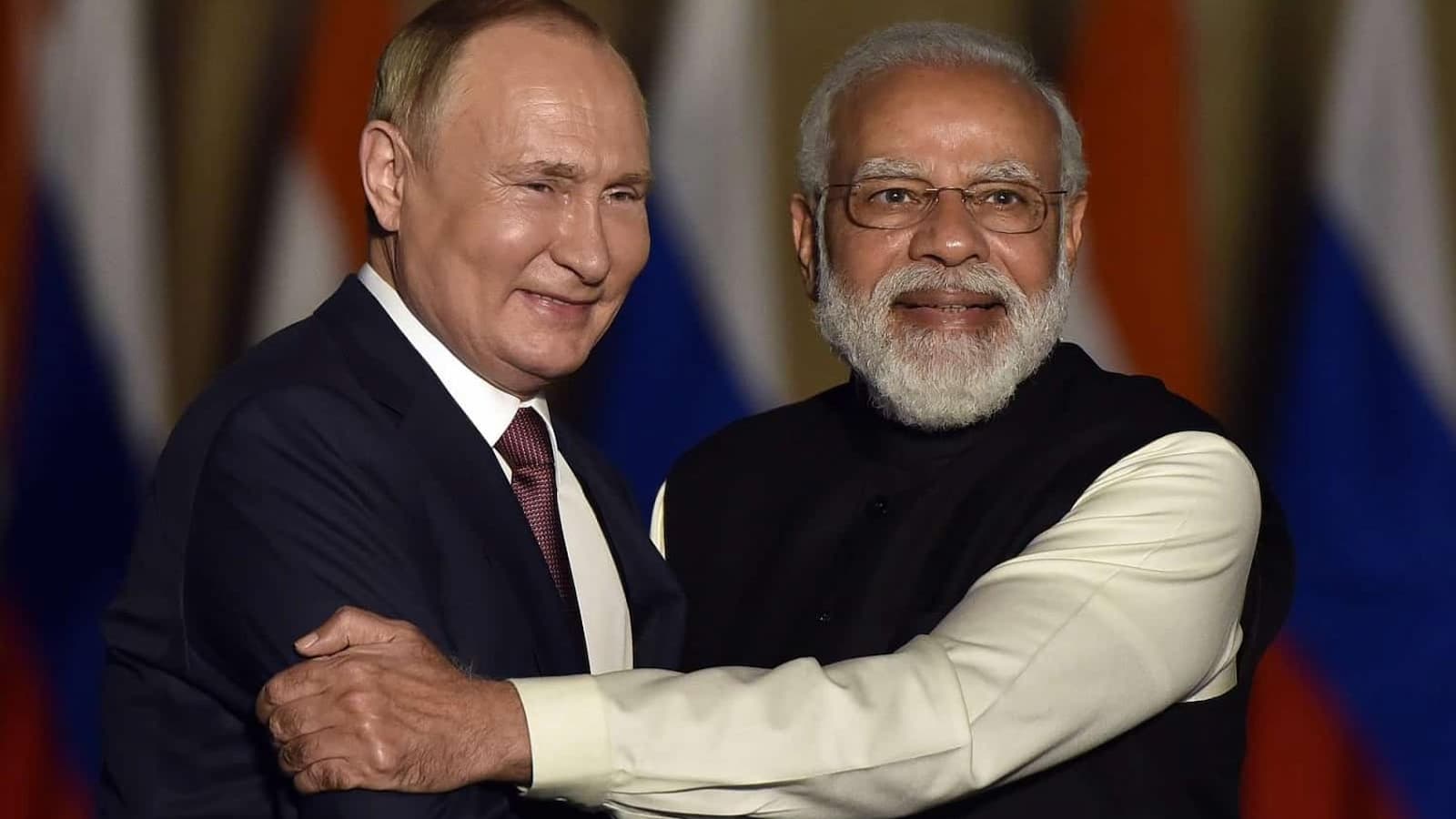
India-Russia Defence Ties: Russian President Vladimir Putin has received an official invitation from Prime Minister Narendra Modi to visit India, with the details of the visit expected to be finalized in early 2025, the Kremlin announced on Monday. This will be Putin’s first visit to India since the start of the Russia-Ukraine conflict in February 2022, highlighting the growing ties between the two nations despite shifting global geopolitics.
The visit is likely to be part of an ongoing framework for regular annual visits between the leaders of Russia and India. Putin’s trip is set to further strengthen the long-standing strategic partnership between the two countries.
Ahead of President Putin’s visit, Indian Defence Minister Rajnath Singh will travel to Moscow from December 8 to 10, 2024. During this three-day trip, he will oversee the induction of the Russian-built frigate, INS Tushil, into the Indian Navy. This event marks the first time in ten years that India will induct a warship built in Russia. The induction of INS Tushil highlights the ongoing strength of India-Russia defence ties and further contributes to India’s naval modernization efforts.
India Becomes First to Develop Long-Range Hypersonic Missile: Defence Experts
According to Business standard, Kremlin aide Yury Ushakov, during a press briefing, expressed optimism about the visit: “Our leaders have an agreement to hold meetings once a year. This time, it’s our turn. We received Modi’s invitation and we will certainly consider it positively. We will figure out the tentative dates early next year.”
INS Tushil: A Key Addition to the Indian Navy
INS Tushil is an advanced, multi-role frigate that will significantly enhance India’s maritime capabilities. This ship is part of a 2018 defence agreement between India and Russia, which involves the acquisition of four Grigorovich-class frigates. Equipped with cutting-edge technologies, including BrahMos supersonic cruise missiles, INS Tushil will strengthen India’s ability to carry out a wide range of naval missions.
The ship is set to be inducted into the Indian Navy during Defence Minister Rajnath Singh’s visit to Moscow in December, marking an important milestone in India-Russia defence relations. Admiral Dinesh Kumar Tripathi, Chief of the Indian Navy, confirmed that INS Tushil is fully prepared for induction, stating, “Tushil is fully ready; we are waiting for it to join the Navy.” This addition will complement India’s existing fleet of Russian-built warships, including the Talwar-class and Teg-class frigates.
The second frigate, INS Tamal, is scheduled to join the Indian Navy by 2025, following its construction at Russia’s Kaliningrad Shipyard. Like INS Tushil, INS Tamal will add to India’s fleet of Russian-built warships, including the Talwar-class and Teg-class frigates, further boosting the country’s naval defence capabilities.
Russia’s Role in India’s Defence Strategy
While Russia has historically been a major supplier of defence equipment to India, its share in India’s military imports has decreased in recent years. A decade ago, Russia accounted for about 70% of India’s foreign weaponry, but today this figure stands at around 40%.
The ongoing Ukraine conflict has disrupted Russia’s defence production, contributing to this decline. Despite these challenges, India continues to rely on Russian technology, particularly in areas like air defence. However, there have been delays in the delivery of the S-400 air defence systems, with two squadrons now expected only by 2026.
Additionally, India is awaiting the lease of a nuclear-powered attack submarine from Russia, with delivery now scheduled for 2028. This delay further complicates India’s defence procurement. Despite these setbacks, India remains focused on strengthening its domestic defence capabilities, with projects like the LCA Tejas fighter aircraft and plans to develop nuclear-powered submarines locally.
Cochin Shipyard Secures Major Contract for INS Vikramaditya in Big ‘Make in India’ Push
India-Russia Defence Ties: Strengthening bilateral cooperation
Alongside diplomatic engagements, Russia and India have been working to boost their economic and business cooperation. Last month, Russia’s First Deputy Prime Minister Denis Manturov visited India to discuss expanding trade and addressing global challenges. During his two-day visit, Manturov participated in the Russian-Indian Business Forum in Mumbai, which focused on strengthening economic ties between the two countries.
While Russia has traditionally been a major supplier of defence equipment to India, its share in India’s military imports has declined in recent years. A decade ago, Russia accounted for about 70% of India’s foreign weapons, but today that figure has dropped to around 40%, primarily due to the ongoing Ukraine conflict, which has impacted Russia’s defence production. Despite these challenges, India still relies on Russian military technology, especially in areas like air defence. However, there have been delays in the delivery of the S-400 air defence systems, with two squadrons expected to arrive by 2026.
During his visit, Manturov also met with Indian leaders in New Delhi and attended the 25th Session of the Intergovernmental Russian-Indian Commission on Trade, Economic, Scientific, Technical, and Cultural Cooperation, further solidifying the ongoing partnership between the two nations.
