

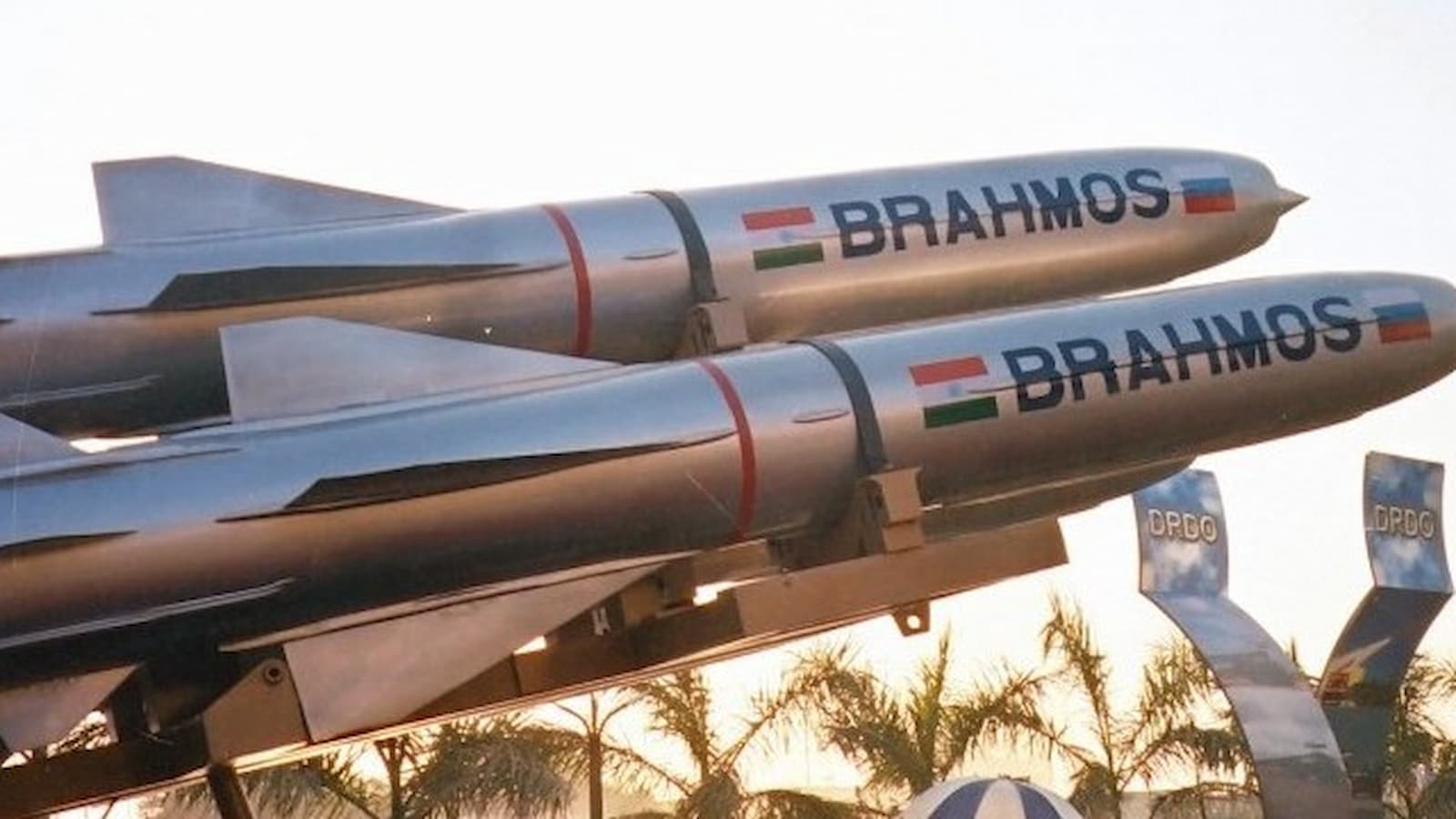
BrahMos Missile India: BrahMos was already showing sharp accuracy during its testing days, and former Army Chief General J.J. Singh later recalled it in a very striking way. He said the missile was so precise that it could, in theory, hit through the “window of the Pakistani Prime Minister’s Office”. He was not talking about a real attack plan. Singh was using a strong picture to explain how exact the missile could be. He had watched the trials himself at Pokhran and approved its use after seeing how well it hit its target.
The missile was developed together by DRDO and Russia’s NPO Mashinostroyeniya, and it quickly became known for its speed and sharp aim. In the early years, the Army was getting ready to use it as a serious strike weapon, and the trust around it was very high. The Ministry of Defence said on June 21, 2007, that President A.P.J. Abdul Kalam handed over a replica of the BrahMos to General Singh to mark the start of delivery to the Army. Kalam also described it as a world-class system and said BrahMos would be a major name in cruise missiles.
Hawk-I 900 Explained: The Indian Radar Designed for MiG-29 and Tejas Fighters
How BrahMos changed India’s strike power
Before BrahMos came in, Indian ground forces had fewer ways to hit faraway targets. They often had to depend on air power or older rocket systems. BrahMos changed that. The missile gave the Army a fast and strong way to attack command centres, supply depots and radar sites from deep inside Indian territory.
In its original form BrahMos had a range of up to 290 km and flew at about Mach 2.8, with a very low terminal altitude of around 10 metres and a conventional warhead of about 300 kg. That mix of speed, low flight and accuracy made it hard to stop and fast to reach its target.
BrahMos is known for a Circular Error Probable of less than 10 metres, which means it can hit very close to where it is aimed. That is why it is seen as a weapon for surgical strikes, not for random wide-area attack. Its guidance system and radar-based terminal lock give it the kind of control that the military wanted from day one. General Singh’s old remark about the Pakistani PM’s office was only a way to explain this precision in simple words.
Zen Technologies Shares Rise 4% After Winning ₹177.5 Crore Defence Contract
Global Export
BrahMos has kept growing after induction. India joined the Missile Technology Control Regime on June 27, 2016, and that helped open the door for longer-range work on the missile family. The BrahMos system today has land, sea, submarine and air-launched versions. The official BrahMos site also says work is moving ahead on BrahMos-NG, a smaller and lighter version meant for more platforms.
The missile has also become an export success. BrahMos Aerospace says the Philippines signed a landmark export deal in January 2022 for shore-based anti-ship batteries, and the first batch was delivered in April 2024.
Reuters and BrahMos’ own media page both reported that delivery. The company says more friendly nations have also shown interest. That makes BrahMos not just an Indian strike weapon, but also a major defence export.
