

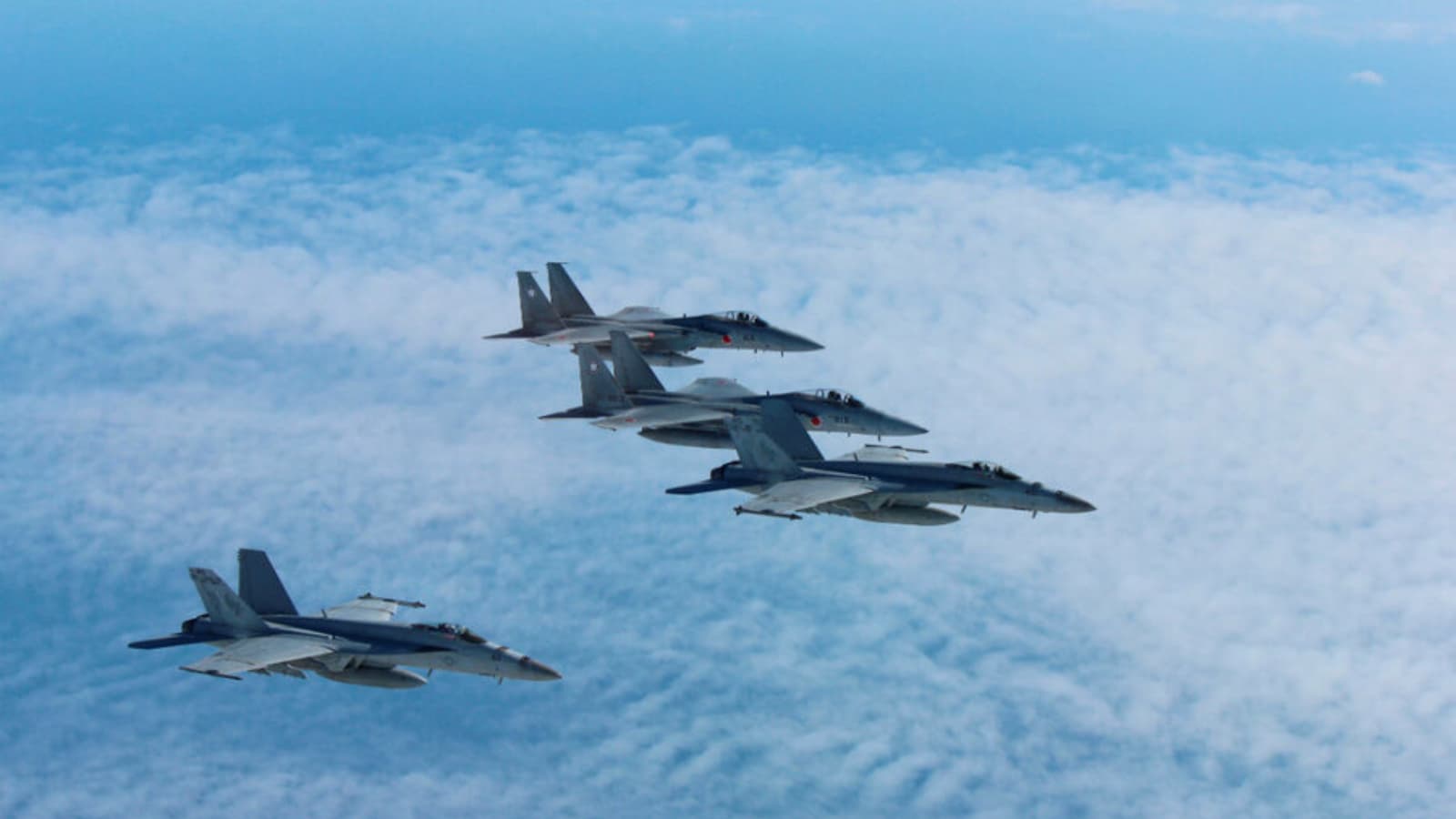
Military Aircraft of US Air Force: As a general rule, militaries worldwide often aim to export their military aircraft to as many friendly countries as possible.
These exports are essential for funding the development of their own highly costly military aircraft. Currently, only the United States and China can afford to develop and maintain their own military aircraft without relying heavily on exports, while Russia no longer fits this category.
5 Military Aircraft of US Air Force
1. Lockheed C-5 Galaxy
| Operator: | United States Air Force |
|---|---|
| Entered service: | 1970 |
| Role: | Strategic airlifter |
The C-5 Galaxy is one of the largest military transport aircraft ever built, with only 131 units produced. Of these, 52 have been upgraded to the C-5M Galaxy variant, enhancing their performance with modern avionics, engines, and other upgrades. Despite its massive size and impressive capabilities, all of these aircraft have been exclusively operated by the United States Air Force (USAF).
All-woman CISF battalion will protect airports, metros, provide VIP security: Amit Shah
While the U.S. may have been open to selling the C-5 to friendly foreign nations, there was little demand for such a colossal transport aircraft from other countries.
The C-5’s size and payload capacity are unmatched by most other military transports, and no other nation had a requirement for such an enormous aircraft, despite similar models like the Soviet-built An-225 and An-124, which are even larger in terms of payload capacity. However, these aircraft are also not typically available for widespread export, making the C-5 Galaxy uniquely reserved for U.S. military use.
2. F-22 Raptor
| Operator: | United States Air Force |
|---|---|
| Entered service: | 2005 |
| Role: | Fifth-gen air dominance fighter |
The F-22 Raptor, introduced as the world’s only fifth-generation fighter until the arrival of the F-35 Lightning II in 2016, was originally planned to have 750 units produced. However, this number was later reduced to 350, and ultimately, only 187 production models were made.
The F-22 remains the top air superiority fighter in the world. Notably, the U.S. imposed an export ban on the F-22, meaning it could only be purchased by the U.S. military.
In contrast, while the U.S. does sell the F-35 to foreign allies and partners, it is very selective about the countries it sells to, often placing stringent conditions on these sales. Every country that has had the opportunity to evaluate the F-35 against current fourth-generation fighters has chosen to purchase it, reflecting the fighter’s advanced capabilities and appeal to U.S. allies.
3. B-2 Spirit
| Operator: | United States Air Force |
|---|---|
| Entered service: | 1997 |
| Role: | Stealth strategic heavy bomber |
This stealth bomber is capable of delivering both conventional and nuclear payloads and is primarily used for long-range, high-priority strike missions.
Its unique flying wing design enhances its stealth capabilities.
Airbus Advocates for Free Trade Amid EU-China Tensions
4. SR-71 “Blackbird”
| Operator: | United States Air Force, NASA |
|---|---|
| Entered Service: | 1966 |
| Role: | High-speed, high-altitude strategic reconnaissance aircraft |
The SR-71 “Blackbird” is widely regarded as a masterpiece of Cold War-era engineering. Capable of exceeding speeds greater than Mach 3, it was used for high-speed reconnaissance flights, gathering vital intelligence from great altitudes. Developed secretly by Lockheed’s Skunk Works during the 1960s, the SR-71 became one of the most famous black projects in the United States.
Although it was retired from U.S. Air Force service in 1989 and fully retired in 1998, rumors suggest that its successor, the SR-72 “Darkstar,” is currently under development by Lockheed Martin.
The SR-72 is speculated to be a hypersonic unmanned aircraft. As with its predecessor, it is believed that the SR-72 may not be made available for export, ensuring that its advanced technology remains exclusive to the United States. There are even claims that Lockheed is in the process of assembling the first SR-72, continuing the legacy of cutting-edge aviation innovation.
5. B-21 Raider
| Operator: | United States Air Force (future) |
|---|---|
| Entered service: | 2027 (planned) |
| Role: | Strategic stealth bomber with multirole capabilities |
The B-21 Raider, as it nears serial production, raises questions about its operators and acquisition numbers. The United States plans to acquire around 100 B-21 bombers to replace its aging B-1 Lancers, although the B-2 Spirits may remain in service until the 2040s.
Historically, the U.S. has not sold modern strategic bombers to other nations, and only China and Russia are considered to have strategic bombing capabilities, with the U.S. unlikely to sell to these countries.
While the UK once had strategic bombing capabilities with the Avro Vulcan, this ended with its retirement. There have been suggestions that Australia might be interested in purchasing the B-21, but such a deal seems unlikely at this time, though not entirely out of the question.
