
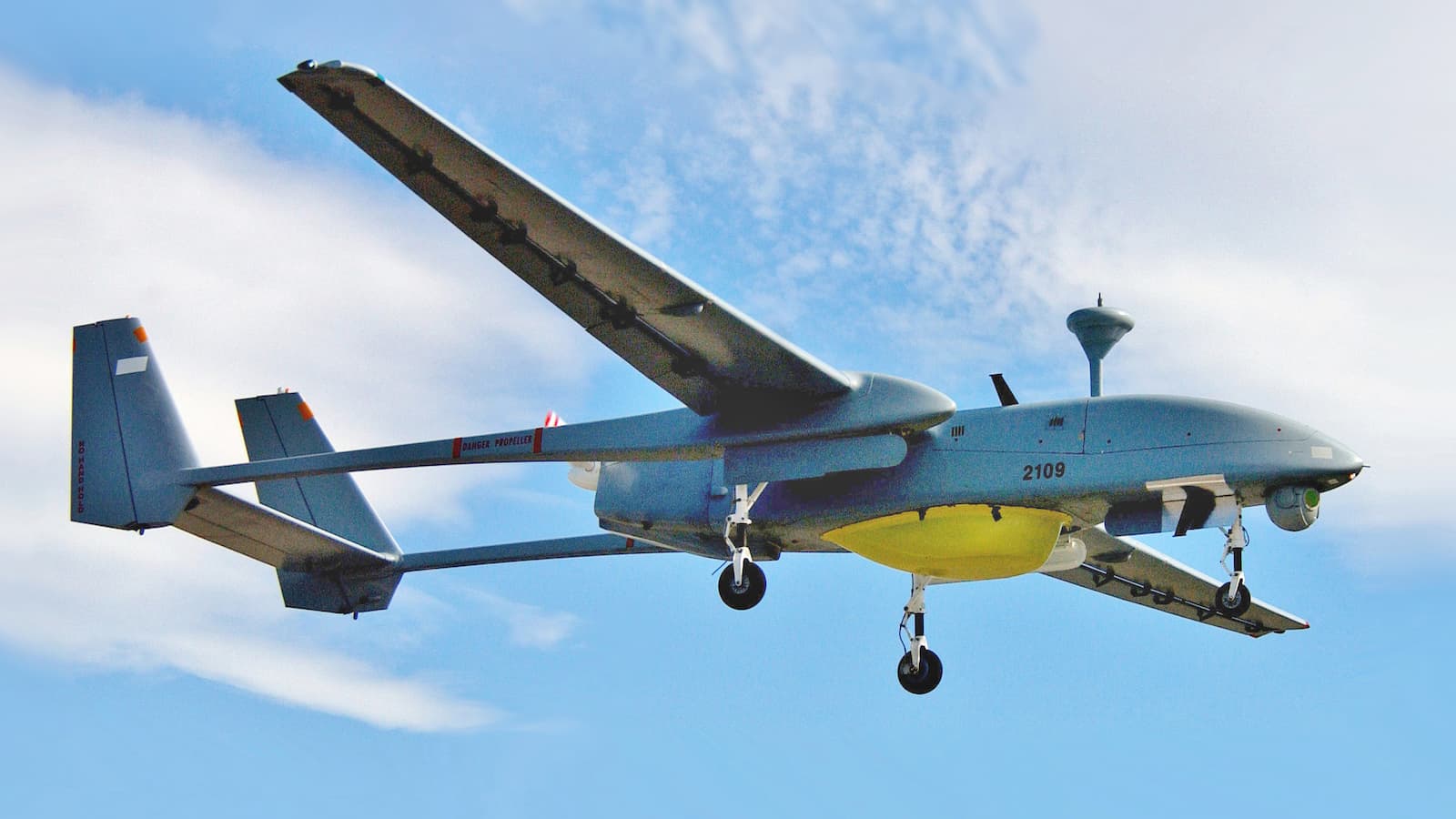
IAF Spy Drones: The Indian Air Force (IAF) plans to buy 500 low-cost, Indian-made spy drones to locate enemy air defence radars. Launched by container or catapult without a runway, they can fly close to enemy positions and return for reuse.
The IAF issued a Request for Information (RFI) on November 18. Indian companies have until January 12, 2027, to respond. After reviewing replies, it will seek “acceptance of necessity” (AoN) before issuing a tender.
Adani Defence Tests Bagheera AT1 Missile System At Pokhran, Check Its Features
Drone features and mission
The IAF wants “low-cost small form factor” drones with the “capability to intercept radar emitters” and “identify direction of intercept”. Electro-optical and infrared cameras will capture day and night images. They must “operate in GNSS denied environments”, or work when satellite navigation is jammed.
Each must reach 25,000 feet, fly for six hours and cover over 200 km. A two-person team should launch them one after another within 10 minutes. Though called expendable, each needs a “safe recovery mechanism so as to be re-used for missions”.
The IAF also wants plans for “collaborative swarm operations”, where drones work together, and “human-on-the-loop” autonomy, where a person supervises the flight. Manufacturers will store and maintain them under “24/7 CCTV surveillance” and deliver them to IAF bases when needed.
Recent wars in Ukraine and West Asia and Operation Sindoor highlight the need for “affordable mass”. During Operation Sindoor, dummy aircraft made to look like fighter jets drew Pakistani air defence radars into action. Their signals revealed their positions, which were then attacked by Israeli-made Harop loitering munitions.
IAF’s surveillance shortfall
The drones will add to the IAF’s intelligence, surveillance and reconnaissance (ISR) network, working close to enemy defences. AWACS watch for enemy aircraft and missiles, while ISTAR planes track ground targets from a distance. The IAF mainly uses Israeli Heron and Searcher drones and has six AEW&C aircraft, compared with around 10 in Pakistan and 30 in China. The Navy has also used its submarine-hunting P-8I aircraft to monitor the Himalayas during tensions with China.
Garuda Aerospace Presents Made-in-India Defence Drones at HADR Exercise 2026
The IAF plans six upgraded Netra Mk-1A and six larger Netra Mk-II aircraft. DRDO gave the indigenous Netra system final operational clearance in June 2026, and Mk-II contracts were signed in July. The IAF’s eight MQ-9B Predator drones are part of 31 ordered from the US for Rs 32,000 crore in October 2024. Deliveries are expected from 2029.
The Defence Acquisition Council has cleared solar-powered “pseudo satellites” for long stays in the stratosphere. The ISTAR plan has faced delays: a $1 billion deal with Raytheon for two aircraft collapsed in 2017. After Operation Sindoor, initial AoN was given for three ISTAR aircraft worth Rs 10,000 crore, but the contract is pending. A separate Rs 30,000-crore project for 87 medium-altitude long-endurance drones received around 10 bids in June and remains under review.
Their price is confidential, but they’re expected to cost far less than larger platforms, making losses easier to absorb near enemy defences.
